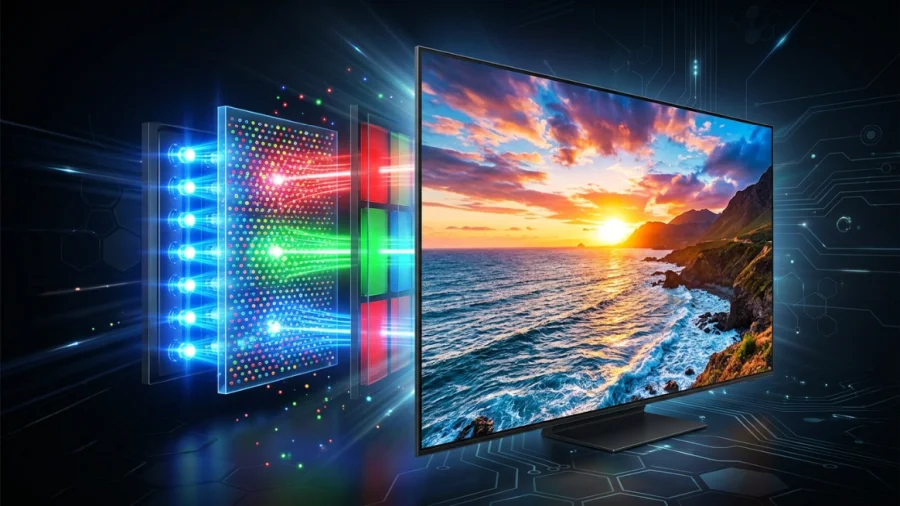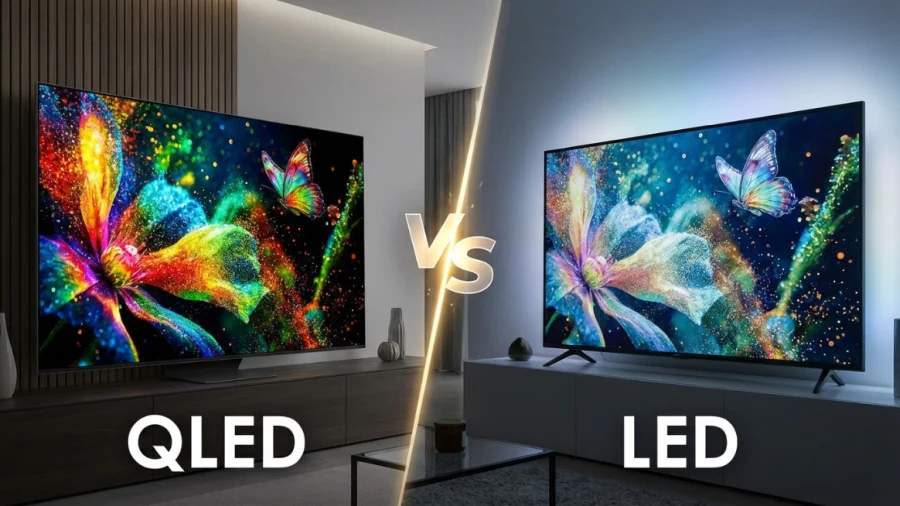
Walk into any electronics store today and you will be confronted by a wall of televisions, each one competing for your attention with specs, buzzwords, and price tags that seem designed to confuse rather than inform. QLED this, LED that. It can be hard to know where to even start.
The good news is that the difference between these two technologies is simpler than the marketing makes it sound. This guide cuts through the noise and explains what actually matters when choosing between QLED and LED, so you can make a confident decision without needing an engineering degree.
Understanding LED Technology
LED televisions are, at their core, LCD (Liquid Crystal Display) panels that rely on LED (Light-emitting diode) backlighting to produce an image.
The liquid crystals do not emit light on their own; instead, the LEDs behind or around the panel shine through them to create the picture you see.
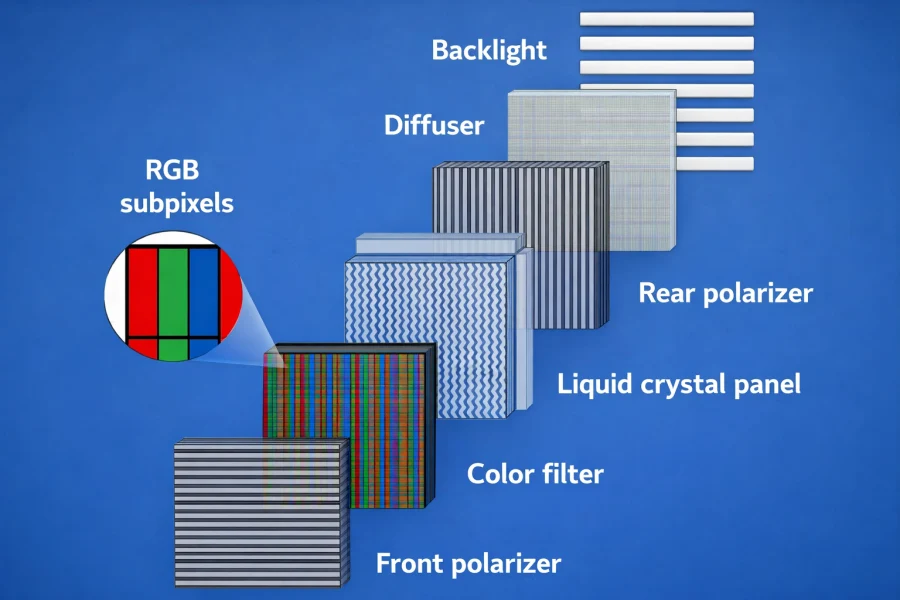
There are two main backlighting approaches. Edge-lit LED TVs place the LEDs along the edges of the screen, which allows for slim profiles but can lead to uneven lighting across the panel.
Full-array LED TVs distribute LEDs across the entire back of the screen, offering more uniform illumination and better local dimming capabilities, where sections of the backlight can be turned down independently to improve contrast.
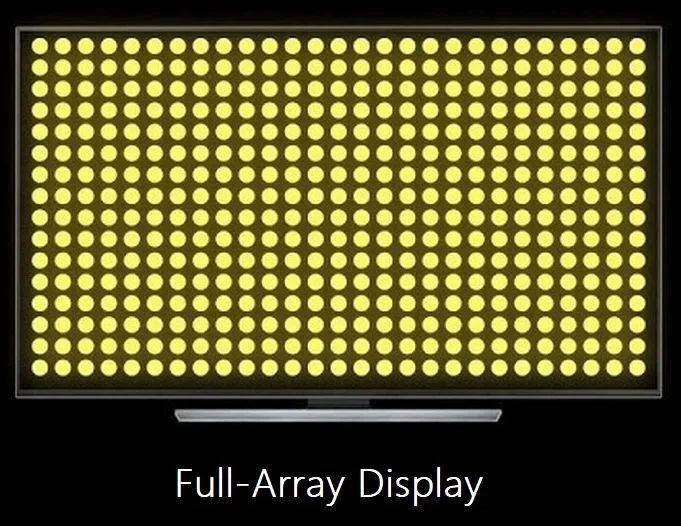
LED technology became the dominant display format through the 2010s, replacing older CCFL (fluorescent) backlighting. It offered improved energy efficiency, thinner designs, and better brightness compared to its predecessors.
Today, LED TVs are widely available at nearly every price point, making them the go-to choice for budget-conscious buyers and casual viewers alike.
Understanding QLED Technology
QLED builds directly on LED foundations but introduces a key upgrade: a quantum dot filter. Quantum dots are nanoscale semiconductor particles that, when struck by light, emit very precise wavelengths of color.
This results in a broader color spectrum, higher peak brightness, and more accurate color reproduction compared to standard LED panels.
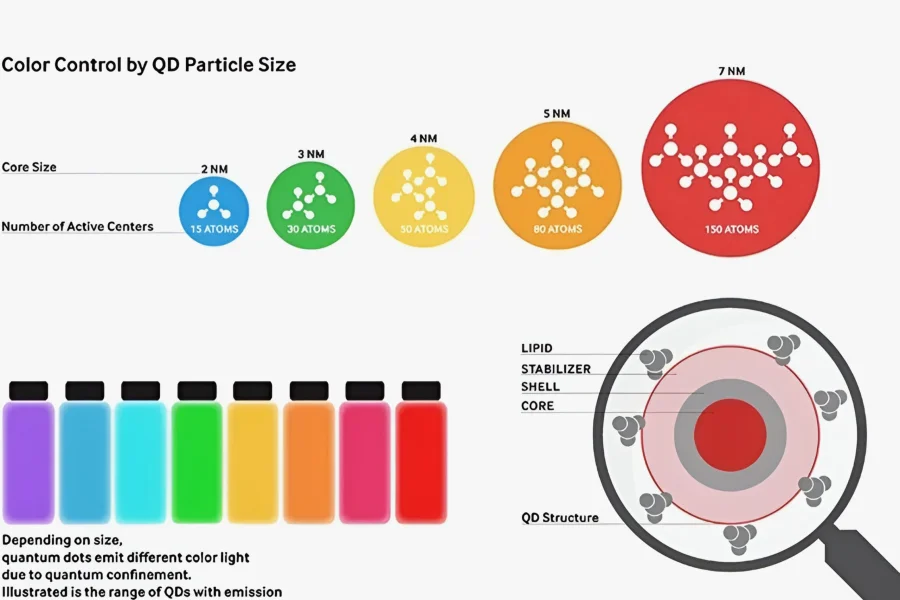
Samsung pioneered the QLED branding and remains its most prominent advocate, though manufacturers like TCL and Hisense have adopted quantum dot technology under their own branding.
It is worth noting that QLED is technically a marketing term rather than a fundamentally different display type. The screen is still an LCD panel with LED backlighting; the quantum dot layer is an enhancement rather than a reinvention.
That said, the enhancement is meaningful. QLED TVs consistently deliver more vibrant, lifelike colors and higher brightness levels than comparable standard LED sets. This makes them particularly well-suited to HDR (High Dynamic Range) content, where the ability to render a wide range of brightness and color is critical to the viewing experience.
QLED vs LED: Head-to-Head Comparison
Picture Quality
Picture quality is where the gap between QLED and standard LED becomes most noticeable.
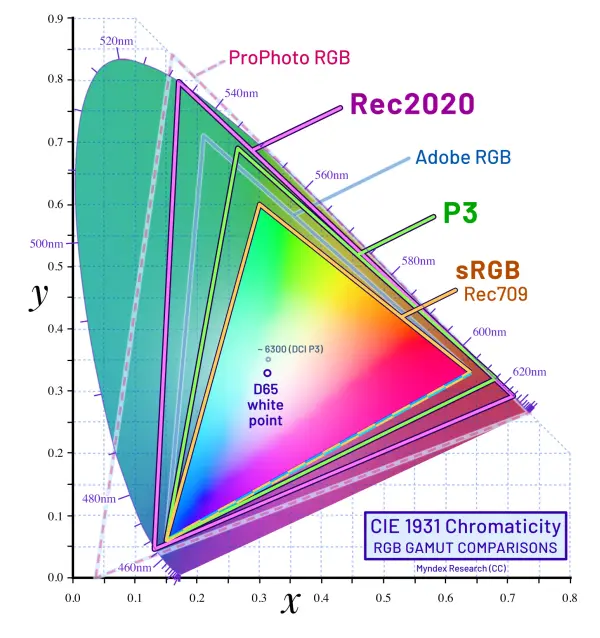
Color accuracy and volume are significantly better on QLED panels. The quantum dot layer can cover up to 100% of the DCI-P3 color space, the industry standard for cinema content, compared to around 70-80% for most standard LED sets. This translates to richer reds, deeper greens, and more nuanced skin tones.
Brightness is another area where QLED pulls ahead. Many QLED TVs reach peak brightness levels of 1,500 to 2,000 nits or higher, which is essential for HDR performance. A standard LED TV typically tops out around 400 to 600 nits at the mid-range tier.
Black levels and contrast are where standard LED technology shows its biggest weakness. Because the backlight is always on to some degree, achieving true black is difficult. QLED TVs with full-array local dimming can improve this considerably, though neither QLED nor standard LED can match the perfect blacks produced by OLED panels.
Viewing Experience
Viewing angles have historically favored neither technology. Both QLED and standard LED TVs use LCD panels, which can suffer from color and brightness degradation when viewed from off-center angles. Some premium QLED models include upgraded panel types (such as IPS or VA) that partially address this, but it remains a category where both technologies lag behind OLED.
Reflection handling is generally solid on both, with many mid-to-high-end models offering anti-reflective coatings. QLED’s higher brightness gives it an additional edge in bright rooms, since the image stays visible even against strong ambient light.
Motion handling depends more on the specific model than the technology type. Features like variable refresh rate (VRR) and high refresh panels (120Hz and above) are available across both LED and QLED lineups, particularly at higher price points.
Size and Design
Both LED and QLED TVs are available in a wide range of screen sizes, from compact 43-inch models to massive 85-inch and above options. QLED TVs, being a premium tier of the LED category, tend to have slightly slimmer profiles at comparable sizes due to manufacturing refinements, though this varies by brand and model.
Most modern versions of both technologies support VESA wall-mounting standards, and bezels have become increasingly slim across the board.
Lifespan and Durability
Both LED and QLED panels are known for their longevity. With normal use, a modern LED or QLED television can last 60,000 hours or more at half-brightness, which translates to well over a decade of regular viewing.
Unlike OLED, neither LED nor QLED panels are prone to permanent image burn-in, making them a safer choice for households where static images (such as news tickers or game HUDs) are displayed for extended periods.
QLED vs LED vs OLED: A Quick Note
No comparison of display technologies would be complete without mentioning OLED. OLED (Organic Light-Emitting Diode) panels are fundamentally different: each pixel generates its own light and can switch off individually, producing perfect blacks and infinite contrast ratios. OLED also excels at wide viewing angles.
However, OLED TVs are more expensive, have lower peak brightness than QLED, and carry a small risk of burn-in with prolonged static image display. For viewers who prioritize absolute contrast and black levels in a dark room, OLED is the gold standard. For those who want maximum brightness and zero burn-in risk, QLED is the stronger choice.
Which One Should You Buy?
Best for gaming: QLED, particularly models with 120Hz panels, VRR support, and low input lag. The higher brightness also helps in HDR gaming titles.
Best for bright living rooms: QLED, without question. Its superior peak brightness and color volume mean the picture remains vivid and clear even in rooms flooded with sunlight.
Best for home theater / dark rooms: A high-end QLED with full-array local dimming will perform well, though OLED is worth considering for the most discerning home cinema enthusiasts.
Best budget pick: Standard LED. For casual TV watching, news, and streaming at standard definition or HD, a well-reviewed LED TV offers excellent value and reliability.
Conclusion
The difference between QLED and LED comes down to one core principle: QLED is a refined, higher-performing evolution of LED technology, not a separate category.
If picture quality matters to you and your budget allows it, QLED delivers a noticeably better experience, especially for HDR content and bright-room viewing. If you are furnishing a bedroom, a child’s room, or simply need a reliable everyday TV without breaking the bank, a standard LED set will serve you well for years to come.
Ultimately, the best TV is the one that fits your viewing habits, your room, and your budget. Use this guide as a starting point, compare specific models within your price range, and prioritize the features that matter most to your daily experience.
Q&A
Is QLED better than 4K LED?
QLED and 4K refer to two different things. 4K describes the resolution of the screen, while QLED describes the display technology. Most QLED TVs are also 4K, so comparing them directly is a little like comparing apples and oranges. If the question is whether a 4K QLED outperforms a 4K standard LED, then yes, QLED generally wins on color and brightness.
Is LED or QLED better for eyes?
Neither technology is inherently easier on the eyes than the other. That said, QLED’s higher brightness paired with local dimming can reduce the harsh contrast between a bright screen and a dark room, which is a common cause of eye strain. Regardless of which you choose, adjusting brightness to match your room lighting will make a bigger difference than the panel type.
Is QLED worth the extra over LED?
It depends on how and where you watch. If you have a bright living room, watch a lot of HDR content, or use your TV for gaming, QLED is worth the premium. If the TV is for a bedroom or casual daytime viewing, a good LED set will serve you just as well for considerably less money.
Will I notice the difference between LED and QLED?
Most people will, yes, especially side by side. Colors appear more vivid and saturated on a QLED, and the picture holds up better in bright rooms. On a smaller screen or in a dim room, the gap narrows, but on a 55-inch or larger panel with HDR content playing, the difference is hard to miss.
What lasts longer, LED or QLED?
Both technologies have very similar lifespans. A well-made LED or QLED TV should last around 60,000 hours at typical brightness settings, which works out to well over a decade of normal daily use. Longevity comes down more to build quality and the brand than to whether the panel has quantum dots or not.
Read Next
HDR400: Understanding Entry-Level HDR Display Technology
LG 32GQ950-B Review: Nano IPS 1ms (GtG) 144Hz; High-End 4K Gaming
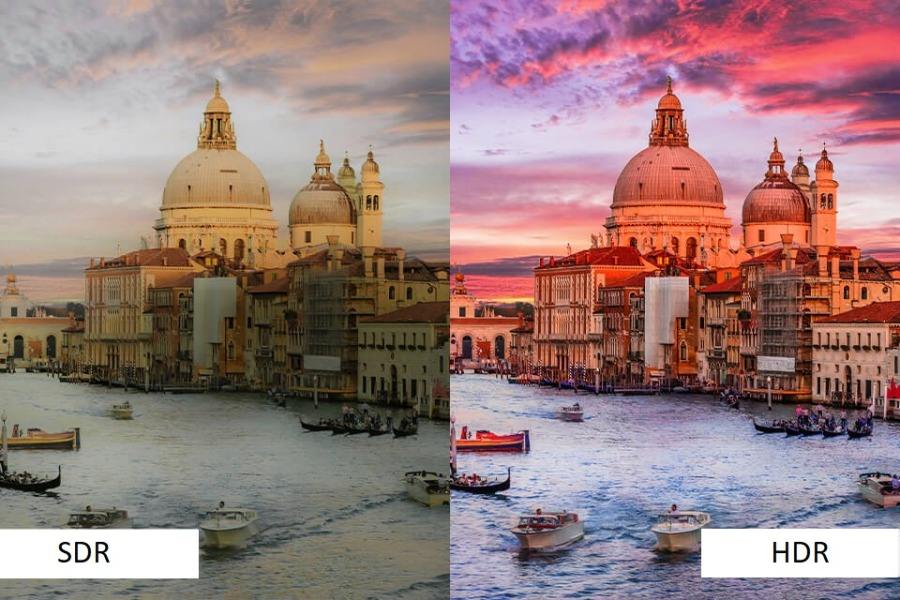
HDR vs SDR: What You Need to Know
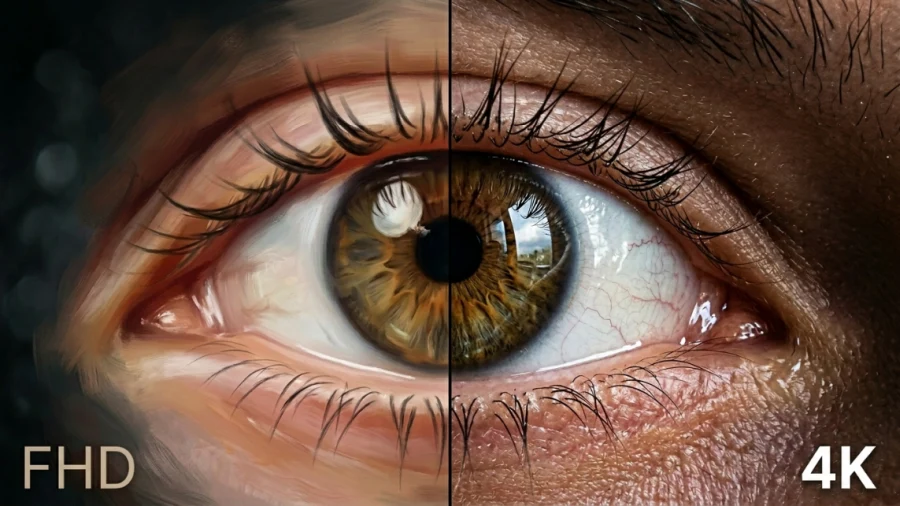
FHD vs 4K: Is the Upgrade Worth It?
Samsung Odyssey OLED G8/G80SD S32DG80 Review: 4K 240Hz 0.03ms; Ultra-Sharp Masterpiece for Gamers
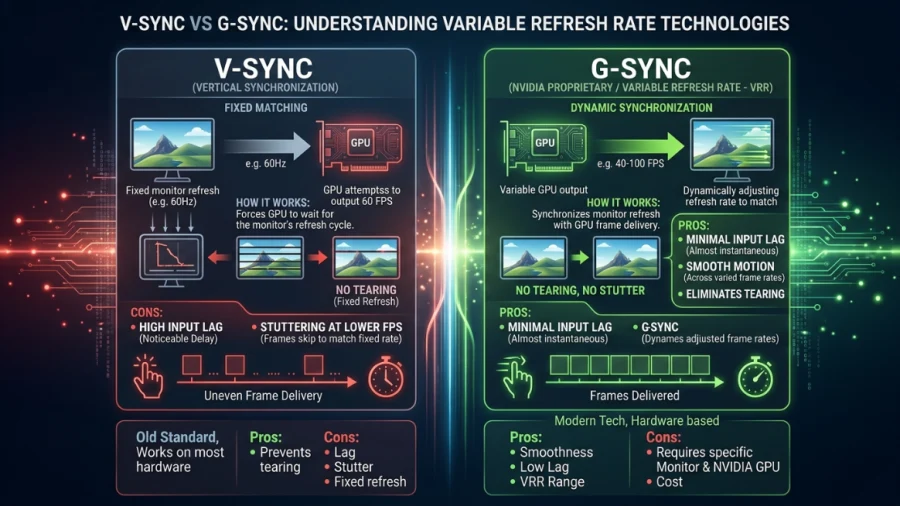
V-Sync vs G-Sync: Which Should You Use?
QLED vs UHD: What’s the Difference and Which One Actually Matters?
GTG vs MPRT: Display Response Times Explained

UWQHD: Ultra-Wide Quad HD Resolution Explained
UWQHD vs 4K: How to Decide Between Ultra-Wide and Ultra-Detail
Local Dimming On or Off: A Guide to the Best Settings
Full Array LED vs OLED: Which Display Technology is Right for You?
1440p vs 1080p: Which Resolution Should You Choose?