
League of Legends ranked is where the game comes alive. It is also where a lot of players hit a wall, because the system that decides your rank has changed more in the last two years than most people realise.
If you stopped playing a while ago, the ladder you remember is gone in several important ways. This guide walks through how ranked works in 2026, from the tiers and the LP math to the newer systems Riot has layered on top, and how to actually climb rather than just grind.
The Ranked Ladder: Ten Tiers, from Iron to Challenger
League has ten ranked tiers. In order from the bottom: Iron, Bronze, Silver, Gold, Platinum, Emerald, Diamond, then the three apex tiers of Master, Grandmaster and Challenger.
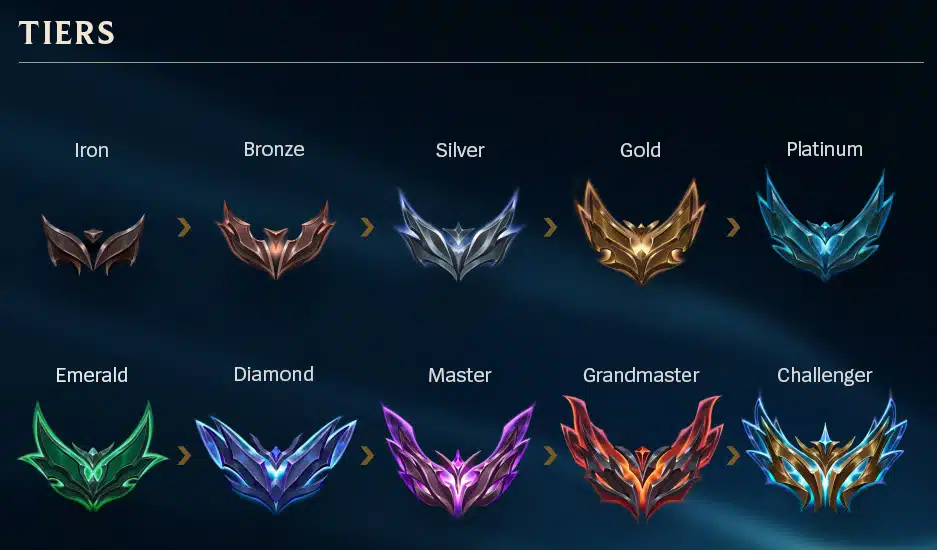
The first seven tiers are each split into four divisions, numbered IV up to I, so you climb from, say, Silver IV toward Silver I before promoting to Gold IV. The three apex tiers work differently.
They are flat pools with no divisions, ranked purely by League Points, and reserved for the top fraction of a percent of players on each server. Challenger sits at the very peak and is capped at a fixed number of spots per region.
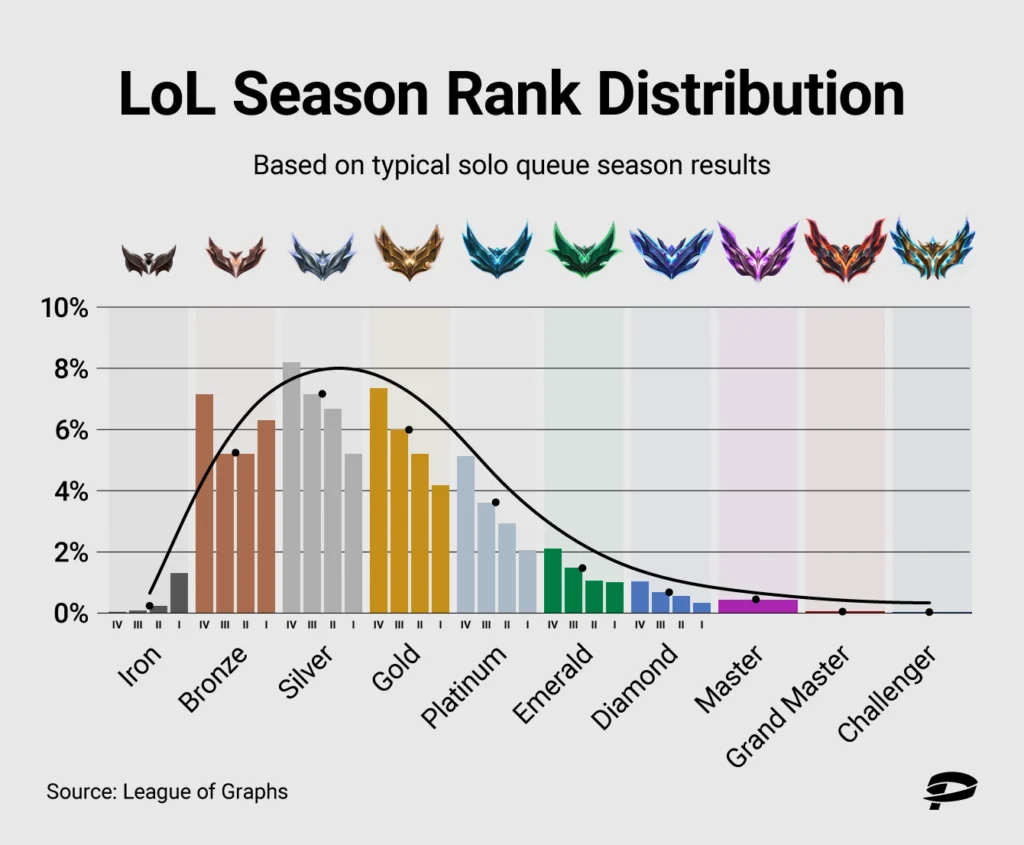
Most of the player base clusters in the middle. Emerald became the rough midpoint of the ladder after Riot introduced it between Platinum and Diamond, and simply reaching it now puts you comfortably in the upper half of all players.
How LP and MMR Actually Work
You earn League Points (LP) when you win and lose them when you lose. Hit 100 LP in a division and you promote automatically.
There are no promotion series anymore. Riot removed the old best-of-three and best-of-five promos back in 2023, and crossing 100 LP now advances you with no extra hurdle.
How much LP you gain or lose depends on your hidden matchmaking rating, or MMR. This is the number the system actually uses to place you in games, and it works quietly in the background.
If your MMR is higher than your visible rank, you gain more LP per win and lose less per loss, because the system thinks you belong higher and is pushing you up. If your MMR is lower than your rank, the opposite happens.
The rough 2026 numbers look like this. Below Emerald, you gain and lose around 25 LP per game when your rank and MMR are aligned. From Emerald upward, that settles to around 20. In the apex tiers, baseline LP was raised to around 30 per game, with the exact swing depending on how far your MMR sits from the pack.
The practical takeaway is simple. If you are gaining far more than you lose, your MMR is ahead of your rank, and you should keep playing while the climbing is easy. If every win is worth a trickle and every loss stings, your MMR has some catching up to do, and consistency is what fixes it.
Placements and The Start of a Season
Getting your rank each season starts with five placement games, down from the ten that older guides still mention. During placements, you cannot lose LP. You only gain, so a rough game does not set you back; it just earns you less.
There is a ceiling worth knowing about: you cannot place higher than Diamond III on placements alone, even if you finished the previous season in Challenger.
Your placement MMR is seeded from your recent normal and ranked history, so the system already has a sense of your level before you begin, and most returning players land a few divisions below their previous peak before climbing back.
The 2026 Season Structure
This is one of the biggest changes from the League many players remember. The ranked year is now split into three seasons rather than two, running from January, April and August.
Each new season brings a reset that knocks your visible rank down and partially adjusts your MMR, so everyone re-places and re-climbs three times a year rather than settling in for a long single grind.
Season boundaries matter for rewards too, since ranked reward missions and seasonal cosmetics are tied to how you finish. If you have a rank goal, the end of a season is a hard deadline, not a soft one, so it pays to know when the current season closes.
The Newer Systems You Need to Understand
Riot added several systems in 2026 that change how the ladder feels, and knowing them helps you avoid nasty surprises.
Aegis of Valor protects players who get autofilled or who queue for priority roles. If you earn a solid performance grade while under its protection, a win gives you double LP and a loss costs you nothing. It is Riot’s way of softening the old penalty of being forced off your main role.
Harsher dodge penalties at the top. In the apex tiers, dodging champion select now counts as a full loss, hitting both your LP and your MMR. Dodging a genuinely doomed lobby can still be worth it lower down, but at Master and above the cost is steep.
The apex reset. Partway through 2026, Riot hard-reset every Master, Grandmaster and Challenger player in the major regions back to Master at zero LP, wiping both visible rank and MMR to clean up ladder integrity. It is a reminder that the top of the ladder is more volatile than it used to be.
Flex MMR alignment. Flex queue MMR is now pulled toward your Solo/Duo MMR, though your Solo/Duo rank is never affected by how you play Flex. The two ladders remain separate, but they are no longer completely independent.
How to Climb Faster
Climbing rewards good habits far more than raw hours, and a few principles make a real difference.
Play a small pool of champions rather than a large one, because mastery of two or three picks beats a shallow understanding of ten. Focus on your own improvement rather than blaming teammates, since the only variable you fully control across hundreds of games is yourself.
Learn to play around your MMR, pushing hard when you are gaining extra LP and taking breaks before a losing streak drags your rating down. And climb one role well rather than filling everywhere, because deep knowledge of a single role’s matchups and map influence compounds over time.
For players who are short on time, or who want to reach a specific rank before the season closes, a LoL boost is one way to reach a target division without grinding through every placement and plateau yourself.
Whether you climb the whole way solo or get help over a rough patch, the aim is the same: to end the season at a rank that reflects how you actually play.
FAQ
How many placement games are there in 2026?
Five per queue, down from the old ten. You cannot lose LP during placements, and you cannot place higher than Diamond III on placements alone, regardless of your previous rank.
Are promotion series still in the game?
No. Riot removed division and tier promotion series in 2023. Once you hit 100 LP in a division, you promote automatically with no extra series to win.
What is the difference between LP and MMR?
LP is the visible number that tracks your progress within a division. MMR is the hidden skill rating the system uses to match you and to decide how much LP you gain or lose. When your MMR is higher than your rank, you gain more and lose less as the system moves you upward.
How often does the rank reset now?
Three times a year. The 2026 season is split into three seasons starting in January, April and August, each with its own reset and reward missions, replacing the older two-split structure.
What is Aegis of Valor?
A 2026 system that protects autofilled and priority-role players. Earn a good enough performance grade while protected, and a win grants double LP while a loss costs no LP, reducing the penalty for being forced off your main role.
The Bottom Line
League of Legends ranked in 2026 is a tighter, faster-moving system than it was even a couple of years ago. Three seasons a year, no promotion series, five-game placements, and a stack of new systems like Aegis of Valor and the apex reset all change how you should approach the climb.
Understand how LP and MMR interact, play to your strengths, and treat each season as its own race, and the ladder becomes far less mysterious and a lot more rewarding to climb.
Read Next

HDR10 Pro: LG’s Enhanced HDR Processing Technology

Direct Lit vs Edge Lit vs Full Array: Decoding TV Backlight Technology

LTPO OLED Display Technology: AMOLED Gets Adaptive

Mini LED vs OLED: Which Display Technology Reigns Supreme?

HDR Tone Mapping on TVs

4K Resolution: Ultimate Experience for TVs and Monitors

LG UltraGear 24GQ50F-B Review: 1920×1080 165Hz 1ms MBR FreeSync Premium; Essential Features Without Breaking the Bank
Google TV vs Samsung Tizen: Which Smart TV Platform Is Right for You?
Full Array LED vs Mini-LED: Decoding the TV Backlighting
QHD vs. OLED: Resolution, Panel Tech, and What Actually Matters

Retina Displays vs. 300 DPI: A Deep Dive into Perceived Resolution

PHOLED vs OLED: Understanding the Differences and Advantages

HDR10 vs HDR10+ vs Dolby Vision: HDR Formats Explained